Showing posts with label rainbow. Show all posts

Wednesday, November 01, 2017

Menorah Experiment: From a Half-Bow to a Full Circle

Article Summary

This post revisits an early experiment made with an ornamental Menorah. By using its seven branches as a painting tool, I explored how the lampstand’s half-circle or half-bow shape could form a complete circular bow. The result later became part of my wider research into the Menorah, light, fire, heaven, earth and the rainbow around God’s throne. An original Suno-assisted song of praise is also shared near the end.

Rediscovering an Old Experiment

While unpacking my study materials, I came across an old experiment I had conducted with a Menorah ornament. I could not remember whether I had shared the result, so I decided to preserve the image and observation here.

Looking at the ornament from the front, I noticed that the outer shape of the Menorah resembles half a circle—or what we could call half a “bow.” The positions for the flames point upwards towards heaven, while the imagined continuation of the bow led me to think about a connection extending towards earth.

Original Menorah ornament experiment showing a circular painted bow
Original image of the Menorah ornament experiment.

How I Conducted the Experiment

  1. I cut cotton buds, also called Q-tips, in half.
  2. I hot-glued them to the places on the ornament that would normally hold the lamps or candles.
  3. I applied the three primary colours to the cotton tips.
  4. I used the ornament as a painting tool, moving it clockwise to carry the half-bow shape around into a full circle.

The movement produced a circular rainbow-like pattern. What appeared to be only half a bow when the Menorah was viewed upright became a complete circle when the shape was carried through a clockwise motion. The resulting bow also appeared to contain an eye-like form near its centre.

The Menorah, Oil and Light

My ornament was designed to hold candles, but the biblical Menorah was a seven-lamped golden lampstand supplied with pure olive oil. Exodus 25:31–40 describes its construction, while Exodus 27:20–21 describes pure pressed olive oil being brought for the light.

“You shall make its seven lamps, and they shall light its lamps so that they may give light in front of it.”

The flames rising from the seven lamps became, for me, a symbolic picture of God’s fire and light. This observation later connected in my research with John’s vision of seven fiery lamps before God’s throne.

“Seven lamps of fire were burning before the throne, which are the seven Spirits of God.”

From a Half-Bow to a Circle

Scripture also describes a rainbow surrounding God’s throne in Revelation 4:3. My experiment did not prove that the Menorah is literally that rainbow. Rather, the circular painted result gave me a visual way to explore a symbolic connection between the lampstand, fire, a bow and the relationship between heavenly and earthly perspectives.

Observation and interpretation

The half-circle shape and painted circle are visible features of the ornament and experiment. The connections with God’s fire, heaven, earth and the rainbow around the throne are my spiritual and symbolic interpretation of what I observed. Scripture does not directly state that the Menorah itself is a rainbow or a map of the heavens.

How This Experiment Led to Later Research

Over the years, I have continued examining the Menorah from different viewpoints, including ground-level and overhead views. That work developed into a much larger study involving circles, triangles, hexagons, the Star of David, the clock structure and what I describe as microcosm and macrocosm Menorah patterns.

Continue reading

My detailed method, figures and later interpretations are available in Unwrapping Menorah Secrets on Project Clock Codes.

SONG UPLOADED 2026

My Suno-Assisted Song of Praise

I also want to share one of my own songs as a musical offering of praise. I sang the song myself and uploaded my vocal recording to Suno. Suno then enhanced my voice and added musical instruments, helping the arrangement sound fuller and more enjoyable while keeping my original sung performance at its centre.

Song Production and Inspiration

The song grew out of a deeply personal predicament that I recorded on 11 February while living in Melbourne. At the time, I was grieving the changes unfolding in my marriage as my now former spouse underwent a gender transition. I was also confronting the difficult reality and consequences that I believed would follow.

The song was birthed while I sat on the bed in our rented Melbourne accommodation, looking through the window. I felt deep sorrow. Just outside stood two trees. As I looked at them, I sensed the Holy Spirit whisper a reminder about the secret I associate with His trees: day after day, through every age and season, they quietly point towards God’s bow in heaven. In that moment, the trees seemed to see what I could not—God’s continual faithfulness, regardless of the circumstances surrounding them.

The song’s verses, therefore, reflect those two trees, which I also see as a type of two pillars. Within my symbolic number interpretation, I connect them with 11—the chapter-and-verse pattern of Genesis 1:1—and with Genesis 2:9, which names the tree of life and the tree of the knowledge of good and evil.

Adding 2 and 9 gives 11, while placing the digits 2 and 9 together produces 29. This led me to Deuteronomy 29:29, which contrasts the secret things belonging to God with the things He reveals. This number connection is my personal symbolic interpretation; it is not a meaning stated directly by Genesis or Deuteronomy.

Original song performed by Anna Towan; vocal enhancement and instrumental arrangement created with Suno.
✨ Deep Treasure

From one viewpoint, the ornament displayed only half a bow. Through movement, that same shape produced a complete circle. This led me to consider how something that appears partial from an earthly viewpoint may reveal a larger pattern when it is turned, extended or viewed from another perspective.

Questions for Further Reflection

  • What does the Menorah’s half-circle shape suggest when viewed as half of a bow?
  • Why did rotating the ornament transform the visible arc into a complete circle?
  • What might change when the Menorah is viewed from ground level compared with an overhead view?
  • How do the seven lamps in Exodus relate to the seven lamps of fire described in Revelation?
  • Where does the experiment provide a visible result, and where does my symbolic interpretation begin?

References

Topics Covered: Menorah experiment, seven-branched lampstand, half-circle, half-bow, circular rainbow, olive-oil lamps, Exodus 25, Revelation 4, seven Spirits of God, symbolic interpretation, original worship song, Suno-assisted music and Project Clock Codes.

Monday, September 14, 2015

Rainbow Teaches Us Unity: Love One Another and Catch the Little Foxes

Article Summary

This devotional reflects on the many colours of a rainbow as a picture of Christian unity. Jesus calls His disciples to love one another, receive one another and guard growing fellowship from the “little foxes” of gossip, bickering, complaining and self-centredness.

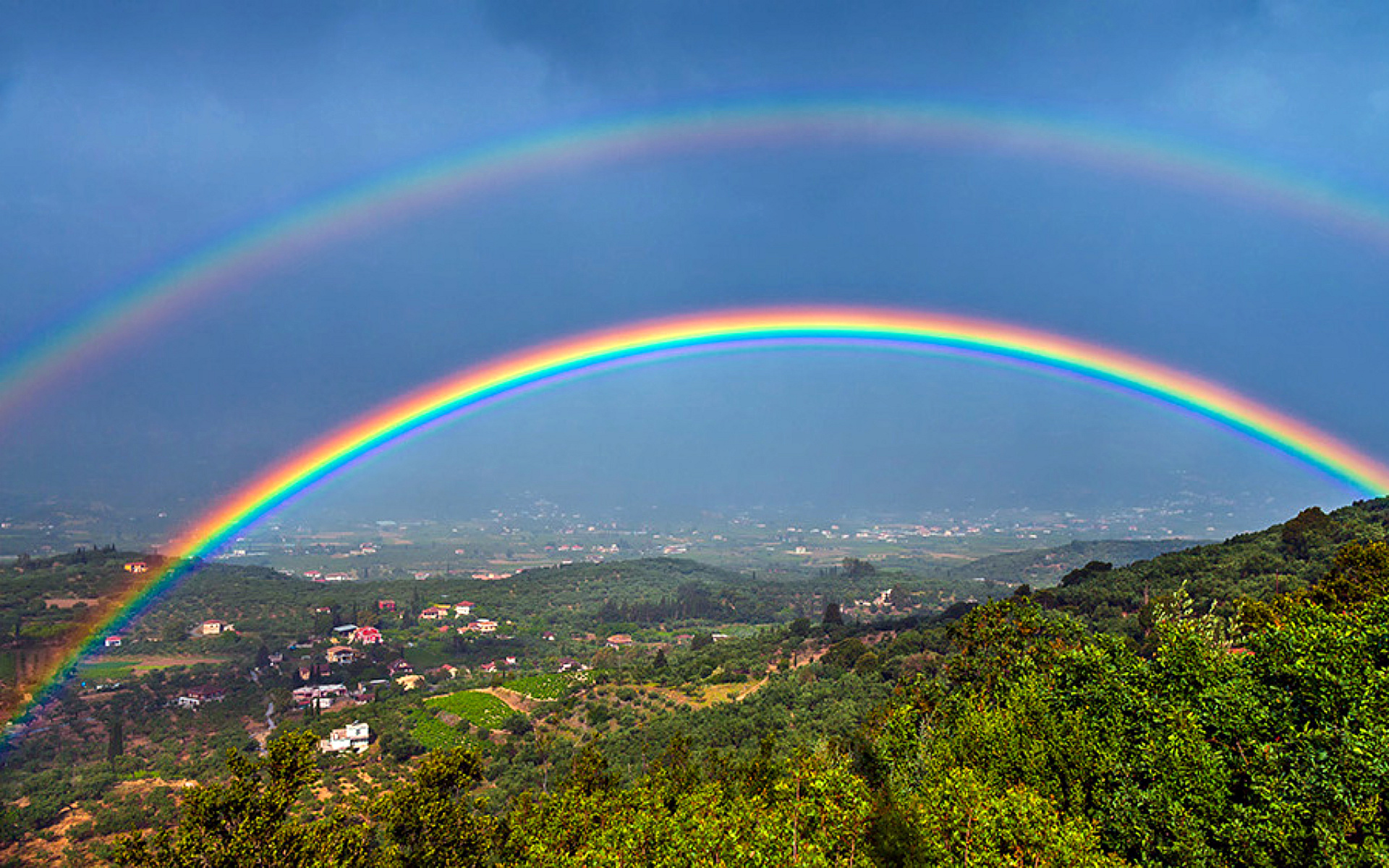
The rainbow is one of the most beautiful sights in the sky. We see it when it rains or after a stormy day, and we are often awed by its beautiful colours forming one arch.

A double rainbow arching across the sky after rain
Double rainbow image.

It is amazing how a rainbow appears to begin at one point and end at another. It is also amazing that many colours form it. If there were only red or blue, one colour by itself would make a plain streak; together, the colours form the beautiful rainbow.

A biblical distinction: In Scripture, the rainbow is directly identified as the sign of God’s covenant with the earth after the flood (Genesis 9:12–17 NKJV). Using its many colours as a picture of Christian unity is my devotional reflection rather than a second biblical definition of the rainbow.

Many Colours, One Loving Witness

This is how we who love Jesus Christ, our Lord and Saviour, should seek to live. We should love one another and respect the different spiritual and practical gifts God has given us. We do not all have to look the same, sound the same or perform the same role. When we work together in love and move towards the same goal in Christ, our shared witness can become something beautiful.

“A new commandment I give to you, that you love one another; as I have loved you, that you also love one another. By this all will know that you are My disciples, if you have love for one another.”

Jesus is clear about how His disciples should respond to one another. Just as the different colours are outstanding when seen together in the rainbow, love makes the unity of believers visible to the world.

How Do We Love One Another?

Love is more than a warm feeling. It chooses truth, patience, hope and endurance:

“does not rejoice in iniquity, but rejoices in the truth; bears all things, believes all things, hopes all things, endures all things.”

Paul also prayed that believers would be like-minded in Christ, glorifying God “with one mind and one mouth,” and receiving one another just as Christ received them (Romans 15:5–7 NKJV). Christian unity is not uniformity; it is shared devotion to Christ expressed through patient, truthful love.

Catch the Little Foxes

To remain in one accord, we should not ignore the little habits that enter our relationships and quietly spoil what is growing.

A group of young red fox kits together outdoors
Red fox kits. Photograph by the U.S. Fish and Wildlife Service, public domain, via Wikimedia Commons.

“Catch us the foxes, the little foxes that spoil the vines, for our vines have tender grapes.”

In its immediate context, Song of Solomon 2:15 is poetic language about protecting tender vines. In this devotional, I apply the “little foxes” as a picture of small destructive attitudes that can damage love and unity if they are allowed to remain.

What might the little foxes look like?

  • Gossip: talking about a neighbour’s faults or calling someone strange instead of praying for them and treating them with dignity.
  • Bickering: becoming upset when another Sunday school volunteer takes the lead, rather than considering what helps the children and trying to understand one another’s cultures, habits and ways of serving.
  • Complaining: criticising the coffee made by a volunteer instead of recognising the time and kindness they offered.
  • Self-promotion: wanting control, attention or gratification more than the good of the group and the glory of God.

These things may seem small, but repeated words and attitudes can nibble away at trust. Catching them early can mean pausing, praying, apologising, speaking directly and choosing a more loving response.

“Rejoice always, pray without ceasing, in everything give thanks; for this is the will of God in Christ Jesus for you. Do not quench the Spirit.”

It is time to live as people of God’s kingdom: praying, believing and acting like love matters.

If You Are Surrounded by Complaining, Flip It

FLIP IT graphic about turning a negative conversation in a positive direction
“FLIP IT” graphic.

If someone comes to you complaining about another person, you can turn the conversation towards gratitude, truth and a constructive response. Flipping it does not mean pretending that every experience was wonderful or saying something untrue. It means refusing to feed needless criticism.

Complainer: “That person’s coffee tasted terrible!”

A loving reply: “It may not have been to your taste, but that person gave their time to serve us. Let’s thank them. If something genuinely needs to change, we can mention it kindly and directly.”

🕊 Remember: Phillipians 2: 14-15 (KJV) “Do ALL THINGS WITHOUT complaining that you (I) may become blameless and harmless child of God without fault.“

This makes it clear that I want to please Jesus rather than join in harmful talk. We can redirect gossip without becoming harsh ourselves, and we can “speak the truth in love” when a real concern needs to be addressed (Ephesians 4:15 NKJV).

God’s Criteria or My Selfish Criteria?

I need to set aside my personal criteria and focus on God’s criteria. That leaves less room for self-promotion, self-gratification and the need to control everything.

God’s criteria (his voice) My selfish criteria (intrinsic & extrinsic)
Love and receive others. My: “Everything should be done my way.”
Be patient and endure with grace. Me: “Why is the weather, service or situation not arranged for me?”
Give thanks and recognise the service of others. I: “I am in control, and when I volunteer everyone must follow my preferences.”
Pray and keep the spiritual connection alive. Complain, compare, demand attention or pursue self-promotion.

God’s timing is perfect. When something does not go my way, I can surrender my expectations to Him and ask how to respond faithfully. I am not the great “I AM”; Jesus is Lord. This was a lesson I learnt at church on 13 September 2015 through Ps Josh Moncrieff.

✨ Deep Treasure

Unity is not sameness. The rainbow is beautiful because its colours remain distinguishable while sharing one arch. In the same way, Christian unity honours different gifts while joining believers in love, truth and devotion to Christ. The “little foxes” often begin as small habits, so love catches them before they spoil what is growing.

A Prayer for Unity

Heavenly Father, thank You for the different people and gifts within the body of Christ. Teach us to love one another as Jesus loves us. Help us catch gossip, bickering, complaining, pride and self-promotion before they damage fellowship. Give us courage to speak truth with love, receive one another with grace, pray without ceasing and give thanks. May we glorify You together with one mind and one mouth. In Jesus’ name, amen.

Questions About Rainbows, Unity and the Little Foxes

Does the Bible directly say that the rainbow represents church unity?

No. Genesis 9 identifies the rainbow as the sign of God’s covenant with the earth after the flood. This post uses its many colours forming one arch as a devotional comparison for believers with different gifts living in unity.

Does Christian unity mean avoiding every disagreement?

No. Love rejoices in truth. Unity calls us to address genuine problems honestly and graciously rather than spreading gossip, humiliating people or demanding our own way.

How can I “catch the little foxes” in everyday life?

Examine your words, refuse to pass on gossip, pray for the person, show gratitude, apologise when necessary and speak directly with love when a concern truly needs attention.

So, unite like the colours of the rainbow, and let the world see the love we have for one another.

Topics Covered: Christian unity, love one another, rainbow devotional, John 13:34–35, Romans 15:5–7, Song of Solomon 2:15, little foxes, gossip, complaining, church relationships, prayer.

Monday, August 17, 2015

Map of God’s Throne Room Hidden in Our Colour Wheel

Article Summary

This devotional explores a connection I noticed between Joseph’s coloured tunic, white light passing through a prism, the rainbow around God’s throne, the twenty-four elders in Revelation 4 and a twenty-four-hue colour wheel. It preserves the excitement of my original 2015 discovery while distinguishing Scripture, optical science and personal symbolic interpretation.

Original reflection: 15 August 2015, at about 11:00 pm

I was reading Panorama of the Old Testament, an A3-size book I had obtained from Koorong, when this chain of connections began unfolding in my thoughts. I felt it continued an earlier insight about the Scriptures testifying of Jesus.

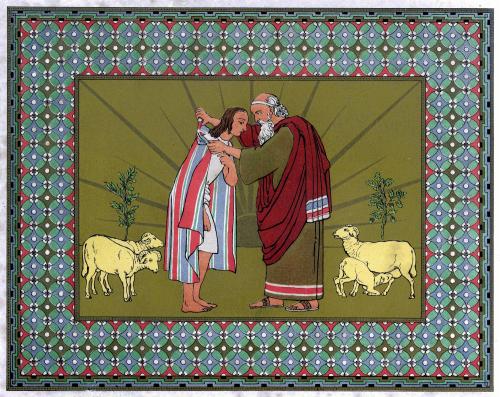
“Now Israel loved Joseph more than all his children, because he was the son of his old age. Also he made him a tunic of many colors.”

Jacob blessing Joseph and giving him a special coat in an 1869 Bible illustration
Jacob blesses Joseph and gives him the coat, illustrated by Owen Jones for The History of Joseph and His Brethren (1869). Public-domain source: Wikimedia Commons.

Joseph, Jesus and a pattern across Scripture

As I pondered Joseph’s story, I remembered Christian teaching that presents Joseph as a biblical pattern pointing toward Jesus. The two lives are not identical, but the parallels can help readers see how themes of rejection, suffering, exaltation and deliverance develop across Scripture.

Pattern Joseph Jesus
Beloved Especially loved by his father (Genesis 37:3) Declared the beloved Son (Matthew 3:17)
Rejected Hated and sold by his brothers (Genesis 37:18–28) Rejected by His own (John 1:11)
Exalted Raised to authority in Egypt (Genesis 41:39–44) Exalted after humbling Himself (Philippians 2:8–11)
Life preserved Used to preserve many lives during famine (Genesis 50:20) Gives eternal life to those who believe (John 3:16)

“You search the Scriptures, for in them you think you have eternal life; and these are they which testify of Me.”

What Joseph’s many colours stirred in me

I began wondering whether the many colours of Joseph’s tunic could be read devotionally as a picture of the many nations and the many kinds of sin for which Jesus gave His life. This is my symbolic reflection; Genesis 37 does not assign that meaning to the tunic. Even the ancient Hebrew description of the garment is translated in different ways, so the NKJV phrase “tunic of many colors” is the particular wording that prompted this meditation.

I also wrote that humanity carries God’s “gene colours.” I now understand that best as poetic language, not biology. Scripture teaches that humanity is made in God’s image and that God is light, but it does not teach that God has human genes or that spiritual identity can be measured as literal colour.

What Scripture says God created humanity in His image; God is light; Jesus is the Light of the world.
My devotional picture The many colours became a way of imagining varied nations, lives, callings and gifts held together in Christ.

White light, the prism and the rainbow

A prism gave me another visual doorway into the subject. White light contains a range of visible wavelengths. Because different wavelengths bend by different amounts as they pass through a prism, the light spreads into a visible spectrum.

Diagram showing a white beam entering a prism and separating into a rainbow spectrum
Dispersion-prism diagram by Suidroot, modified by Sceptre. Wikimedia Commons, licensed CC BY-SA 3.0.

I loved the thought that a glass prism must be positioned at an effective angle for the spectrum to become visible. Devotionally, that reminded me to approach Scripture attentively, patiently and from more than one narrow assumption. The physical angle does not prove a hidden biblical code; it simply became a metaphor that encouraged deeper study.

A natural rainbow is more complex than light passing once through a prism. Sunlight is refracted as it enters a water droplet, reflected inside the droplet, and refracted again as it leaves. Those processes separate the visible wavelengths for the observer.

NOAA diagram showing sunlight refracting and reflecting inside a raindrop before emerging as separated colours
How light travels through a raindrop to form a primary rainbow. Credit: NOAA/JPL-Caltech. Source: NOAA NESDIS / NASA Space Place.

The rainbow around God’s throne

“And He who sat there was like a jasper and a sardius stone in appearance; and there was a rainbow around the throne, in appearance like an emerald.”

Revelation then describes twenty-four thrones around God’s throne, occupied by twenty-four elders clothed in white and wearing golden crowns (Revelation 4:4). The rainbow and the surrounding elders became the centre of my colour-wheel meditation.

A conceptual devotional map created for this post: a rainbow ring, a central throne and twenty-four gold markers. It is not intended as a literal reconstruction of heaven.
An important distinction

Revelation describes a rainbow around the throne and twenty-four elders around it, but the chapter never calls the arrangement a colour wheel. The “throne-room map” is my visual comparison and prayerful interpretation, not a doctrine stated in the biblical text.

Why the twenty-four-part colour wheel caught my attention

I remembered teaching associated with John Paul Jackson that compared the twenty-four elders with twenty-four hues around a colour wheel. When I looked more closely at the wheel I had saved, I saw a pale centre surrounded by named colours and began picturing white light at the centre, colour radiating outward, and the elders encircling the throne.

Warren Mars's Martian Colour Wheel showing twenty-four named hues and five tonal rings
The Martian Colour Wheel, © Warren Mars. The wheel is a modern, human-designed system containing twenty-four named hues and five tonal rings. View the creator’s colour-wheel study.

The fact that this particular wheel contains twenty-four hues is striking beside Revelation 4:4, but colour wheels can be divided into different numbers of segments. Therefore, the numerical match can inspire meditation without proving that every colour wheel is a concealed blueprint of God’s throne room. Yet hint his fingerprint beneath all.

✨ Deep Treasure

The deepest treasure is not that a diagram can prove heaven’s architecture. It is that Scripture, light, colour and creation can awaken us to look again, ask better questions and worship the One whose wisdom is greater than the portion we can presently see.

Colour, callings and the gifts of the Spirit

I wondered whether people might be recognised in the spiritual realm by a “colour calling,” or whether the different gifts of the Holy Spirit might shine like different colours when Jesus is revealed through His people. This remains an open imaginative question. Scripture teaches that the one Spirit distributes different gifts according to His will, but it does not assign a colour to each gift, however, my personal question still remains valid, perhaps each gift does come with special colours and we just cannot see due to our weak, and puny eyesight.

“But one and the same Spirit works all these things, distributing to each one individually as He wills.”

The rainbow as covenant sign

The Bible first identifies the rainbow as God’s covenant sign after the flood. Its direct biblical meaning is His promise that the waters would never again become a flood to destroy all flesh. The New Testament later speaks of the present heavens and earth being reserved for fire and judgment; these are separate biblical teachings and should not be collapsed into the rainbow itself.

God’s covenant sign

“I set My rainbow in the cloud, and it shall be for the sign of the covenant between Me and the earth.”

— Genesis 9:13 (NKJV)

For the later reference to fire and judgment, read 2 Peter 3:7. The rainbow itself remains the Genesis sign of covenant mercy.

The circle we do not usually see

A rainbow is geometrically a complete circle centred on the antisolar point. From the ground, the horizon usually hides its lower portion, leaving us with the familiar arc. From an aircraft or another high viewpoint, the full circle can sometimes become visible.

A complete circular rainbow photographed from an aircraft above clouds
A full-circle rainbow seen from a plane. Credit: NOAA. Source: NOAA NESDIS/NASA Space Place.

The aircraft photograph in my earlier post showed a much smaller ring around the aircraft’s shadow. That phenomenon is called a glory, not a full-circle rainbow. Both are beautiful optical effects, but they are formed differently.

The scientifically accurate full-circle image still carries the devotional lesson that first excited me: from where I stand, I may see only an arc, while God sees what I cannot. The photograph does not prove that spiritual claim; it gives me a vivid picture through which to remember it.

✨ Deep Treasure

My eyes may see only half the bow and part of the story. God is not limited by my horizon. He knows the beginning, the hidden middle and the end, so I can keep seeking His wisdom without pretending that my present interpretation is the whole picture.

God’s fingerprints in wisdom and creation

This reflection taught me to search for God’s fingerprints in Scripture, creation and my own life—and then to respond with worship rather than certainty about every symbol. The Bible celebrates the wisdom of God’s works:

  • Psalm 104:24 marvels at the multitude of God’s works made in wisdom.
  • Proverbs 3:19 says the Lord founded the earth by wisdom and established the heavens by understanding.
  • Job 28:23 reminds us that God understands wisdom’s way and knows its place.

Perhaps the joyful invitation is not to force creation into a secret code, but to remain alert to echoes that lead us back to Scripture, humility, wonder and praise. That is still exciting.

Questions for reflection

  1. Where have I mistaken the part I can see for the whole picture?
  2. Does a symbolic connection draw me closer to the clear teaching of Scripture, or distract me from it?
  3. How can the variety of spiritual gifts deepen unity rather than comparison?
  4. What part of God’s wisdom in creation fills me with worship?

Prayer

Heavenly Father, thank You for the beauty of light, colour, covenant and Your Word. Teach me to notice Your wisdom without claiming more than You have revealed. Help me recognise Jesus throughout Scripture, honour the different gifts You place in Your people and trust You with the parts of the picture I cannot yet see. May every discovery lead me into humility, truth and worship. In Jesus’ name, amen.

Frequently asked questions

Does Revelation 4 say that God’s throne room is a colour wheel?

No. Revelation 4 describes a rainbow around the throne and twenty-four elders on surrounding thrones. Comparing that arrangement with a colour wheel is a devotional interpretation, not an explicit biblical statement.

Why does this colour wheel have twenty-four hues?

Warren Mars designed the Martian Colour Wheel with twenty-four named hues and five tonal rings. Other colour wheels use different numbers of divisions, so twenty-four is a feature of this particular model rather than a rule of colour science.

Is every rainbow a complete circle?

The rainbow’s geometry forms a circle around the antisolar point, but the ground and horizon usually block the lower portion. Under suitable conditions, an observer at altitude can see the full circle.

Does the Bible assign colours to spiritual gifts?

No. First Corinthians 12 teaches that the same Spirit distributes different gifts according to His will, but it does not give those gifts a colour system.

Topics Covered: Joseph’s tunic of many colours, Joseph as a picture of Jesus, white light and prisms, how rainbows form, the rainbow around God’s throne, Revelation 4, the twenty-four elders, the Martian Colour Wheel, spiritual gifts, Noah’s covenant, full-circle rainbows, Christian symbolism and biblical discernment.

Visitors