Showing posts with label Joseph. Show all posts

Sunday, November 13, 2016

Symbols in Joseph’s Dream: The Sun, Moon, Eleven Stars and Egypt

Article Summary

Joseph dreamed that the sun, moon and eleven stars bowed before him. Genesis gives these symbols an immediate family meaning, later fulfilled most plainly when Joseph’s brothers bowed in Egypt. Yet Rachel died after Benjamin’s birth, and Jacob’s reunion with Joseph was marked by an embrace and tears rather than Jacob bowing. This study considers those details alongside a possible secondary Egyptian echo.

The Dream That Shone Like Light

Just like that, the Holy Spirit highlighted for me—almost like light shining in darkness—the significance of Joseph’s second dream. In it, the sun, moon and eleven stars bowed down before him.

At first, Jacob understood the dream as referring to his own household. Yet as I followed Joseph’s story into Egypt, another possible layer came into view: Joseph would eventually be raised above the people of Egypt, and Pharaoh would command the nation to recognise his authority.

What Genesis Says Directly

9 Then he dreamed still another dream and told it to his brothers, and said, “Look, I have dreamed another dream. And this time, the sun, the moon, and the eleven stars bowed down to me.”

10 So he told it to his father and his brothers; and his father rebuked him and said to him, “What is this dream that you have dreamed? Shall your mother and I and your brothers indeed come to bow down to the earth before you?”

11 And his brothers envied him, but his father kept the matter in mind.

Jacob’s interpretation should not be dismissed as simply wrong, because it is the interpretation recorded within the biblical account. He understood the sun as himself, the moon as Joseph’s mother or maternal household figure and the eleven stars as Joseph’s eleven brothers.

The passage does not explicitly say that God concealed an Egyptian meaning from Jacob. What Jacob did not yet know was how, where and when the dream would unfold. Although he rebuked Joseph, verse 11 says that he also kept the matter in mind.

The Family Fulfilment

Years later, famine brought Joseph’s brothers to Egypt in search of grain. They did not recognise the Egyptian governor standing before them, but Joseph recognised them.

“And Joseph’s brothers came and bowed down before him with their faces to the earth.”

This is the clearest literal fulfilment of Joseph’s dreams: the brothers represented by the eleven stars bowed before him, just as their sheaves had bowed to his sheaf in his first dream. They bowed again in Genesis 43:26–28 and Genesis 44:14.

Rachel’s Death and Jacob’s Reunion With Joseph

The sun and moon are more complex than the eleven stars. Rachel, Joseph’s mother, died in hard labour after giving birth to Benjamin. Before she died, she called the child Ben-Oni, meaning “son of my sorrow,” but Jacob named him Benjamin. Jacob then set a pillar over Rachel’s grave. This occurred before the account of Joseph’s dreams in Genesis 37. See Genesis 35:16–20.

Years later, Jacob learned that Joseph was alive and travelled to Egypt. Their meeting was not a scene in which Jacob bowed before his powerful son. It was a deeply emotional reunion between a father and the son he had believed was dead.

“So Joseph made ready his chariot and went up to Goshen to meet his father Israel; and he presented himself to him, and fell on his neck and wept on his neck a good while.”

This can naturally be described as a tearful embrace, although the verse specifically says that Joseph fell on Jacob’s neck and wept for a long time. Jacob responded, “Now let me die, since I have seen your face, because you are still alive” (Genesis 46:30). The text does not record Jacob bowing to Joseph at their reunion.

The direction of the later bow

Genesis later records Jacob bowing at the head of his bed after Joseph swore to bury him with his fathers, but it does not say that Jacob bowed to Joseph (Genesis 47:29–31). In another striking scene, the direction is reversed: Joseph bows with his face to the earth before Jacob brings Ephraim and Manasseh near for blessing (Genesis 48:12). These details show why the dream should not be forced into a simplistic one-to-one physical enactment for every family member.

The sun and moon may therefore represent the wider parental authority or household coming under the protection of Joseph’s God-given position. The eleven brothers bowed literally, while Jacob’s household entered Egypt and became dependent upon the provision God administered through Joseph.

Could Egypt Be a Secondary Symbolic Echo?

Here is the additional connection that struck me: the dream’s celestial symbols may also echo the Egyptian setting in which Joseph’s authority was finally revealed. I present this as a personal symbolic reflection, not as a replacement for Genesis’ family interpretation.

Pharaoh recognised that God had given Joseph unusual discernment and wisdom. He placed Joseph over his house and over the land, gave him the royal signet ring, clothed him in fine linen and had him ride in the second chariot. People were then instructed to cry before Joseph, “Bow the knee!” Pharaoh remained greater in relation to the throne, but he entrusted Joseph with extraordinary administrative power throughout Egypt. See Genesis 41:39–44.

In that sense, Pharaoh did not literally bow before Joseph. Rather, Pharaoh authorised Egypt to bow and yielded the practical government of the land to the wisdom God had placed in Joseph. The nation’s submission can therefore be seen as a possible Egyptian echo of the dream, even though Scripture does not directly label Egypt as the sun, moon and stars.

Comparing the Two Interpretive Layers

Dream symbol   Meaning stated or implied in Genesis 37 Possible Egyptian echo
Sun           Jacob, the father and head of Joseph’s       household. Pharaoh and solar kingship. Pharaoh did not bow literally, but he transferred governing authority to Joseph while retaining the throne.
Moon         Joseph’s mother or the maternal authority   within the household. Rachel died after   Benjamin’s birth, and Scripture does not   record her bowing to Joseph. Ancient Egyptian religion included lunar deities such as Khonsu and Thoth. This cultural association is suggestive, but Genesis does not make the identification.
Eleven stars  Joseph’s eleven brothers, who later bowed    physically before him in Egypt. Egyptian religion also included stellar deities and celestial imagery. More directly, the people of Egypt were commanded to recognise Joseph’s authority.

Sun, Moon and Stars in Ancient Egyptian Religion

The Egyptian connection is culturally understandable because celestial imagery was deeply woven into ancient Egyptian religion. The royal title “Son of Re” is attested in Egyptian kingship; for example, the Metropolitan Museum of Art identifies the title on a relief associated with the Middle Kingdom ruler Amenemhat I. The museum also documents scenes expressing a pharaoh’s adoration of the sun god.

Egyptian religion also included lunar and stellar deities. The Smithsonian’s National Museum of African Art identifies Amun-Re as a primary sun god, Thoth as a lunar deity and Sopdet as the deification of Sirius. This background supports the possibility of a meaningful cultural echo, but it does not prove that Joseph’s sun, moon and stars were secretly coded names for Egypt.

What God Had Hidden Was the Journey

Joseph saw the destination in a dream, but he was not shown the pit, slavery, false accusation, prison, famine or the years that would stand between the promise and its fulfilment. Jacob perceived that the dream concerned the family, but he could not yet see the road by which God would preserve that family through Joseph.

The hidden part was not necessarily the identity of every symbol. It was the astonishing way God would bring the dream to pass. What looked like Joseph’s destruction became the pathway to his appointment, and what looked like a family conflict became part of God’s provision during famine.

“But as for you, you meant evil against me; but God meant it for good, in order to bring it about as it is this day, to save many people alive.”

✨ Deep Treasure

Joseph’s family bowed before the brother they had rejected, while Egypt bowed before the wisdom God had placed within the foreign prisoner it once confined. The dream’s clearest meaning belongs to Joseph’s household, yet Egypt becomes the vast stage on which that promise expands. God revealed the destination early, concealed the painful road and used both family and empire to accomplish preservation.

Questions for Further Reflection

  • Why might God reveal a future outcome without revealing the journey toward it?
  • What part of Joseph’s dream is fulfilled explicitly in Genesis 42?
  • How do Rachel’s death and Jacob’s tearful reunion with Joseph complicate a strictly literal identification of the sun and moon?
  • How does Pharaoh’s command to “Bow the knee” broaden the scale of Joseph’s authority?
  • How can we explore a symbolic connection without presenting it as something Scripture states directly?
  • Am I judging an unfinished promise because I cannot yet see how God could fulfil it?

A Prayer for Wisdom and Patience

Prayer

LORD, thank You for the wisdom hidden in Your Word. Teach me to honour what Scripture says plainly and to hold personal insights with humility. When You reveal a promise but conceal the road, give me patience to trust Your timing. As You did with Joseph, turn what was intended for harm toward Your saving purpose and Your glory. Amen.

Scripture References

Topics Covered: Joseph’s second dream, Genesis 37, sun moon and eleven stars, Rachel’s death, Benjamin’s birth, Jacob and Joseph’s reunion, Joseph’s brothers bowing, Joseph in Egypt, Pharaoh, “Bow the knee,” Egyptian celestial religion, Son of Re, dream fulfilment, biblical symbolism, personal interpretation and God’s hidden timing.

Monday, August 17, 2015

Map of God’s Throne Room Hidden in Our Colour Wheel

Article Summary

This devotional explores a connection I noticed between Joseph’s coloured tunic, white light passing through a prism, the rainbow around God’s throne, the twenty-four elders in Revelation 4 and a twenty-four-hue colour wheel. It preserves the excitement of my original 2015 discovery while distinguishing Scripture, optical science and personal symbolic interpretation.

Original reflection: 15 August 2015, at about 11:00 pm

I was reading Panorama of the Old Testament, an A3-size book I had obtained from Koorong, when this chain of connections began unfolding in my thoughts. I felt it continued an earlier insight about the Scriptures testifying of Jesus.

“Now Israel loved Joseph more than all his children, because he was the son of his old age. Also he made him a tunic of many colors.”

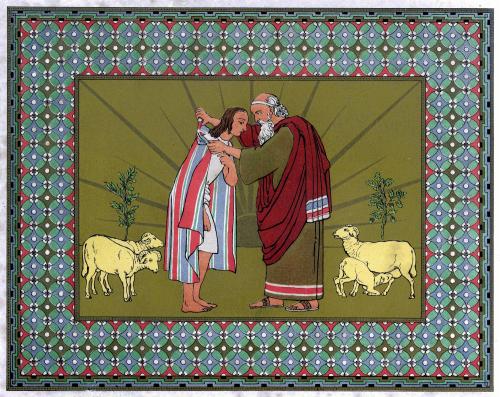
Jacob blessing Joseph and giving him a special coat in an 1869 Bible illustration
Jacob blesses Joseph and gives him the coat, illustrated by Owen Jones for The History of Joseph and His Brethren (1869). Public-domain source: Wikimedia Commons.

Joseph, Jesus and a pattern across Scripture

As I pondered Joseph’s story, I remembered Christian teaching that presents Joseph as a biblical pattern pointing toward Jesus. The two lives are not identical, but the parallels can help readers see how themes of rejection, suffering, exaltation and deliverance develop across Scripture.

Pattern Joseph Jesus
Beloved Especially loved by his father (Genesis 37:3) Declared the beloved Son (Matthew 3:17)
Rejected Hated and sold by his brothers (Genesis 37:18–28) Rejected by His own (John 1:11)
Exalted Raised to authority in Egypt (Genesis 41:39–44) Exalted after humbling Himself (Philippians 2:8–11)
Life preserved Used to preserve many lives during famine (Genesis 50:20) Gives eternal life to those who believe (John 3:16)

“You search the Scriptures, for in them you think you have eternal life; and these are they which testify of Me.”

What Joseph’s many colours stirred in me

I began wondering whether the many colours of Joseph’s tunic could be read devotionally as a picture of the many nations and the many kinds of sin for which Jesus gave His life. This is my symbolic reflection; Genesis 37 does not assign that meaning to the tunic. Even the ancient Hebrew description of the garment is translated in different ways, so the NKJV phrase “tunic of many colors” is the particular wording that prompted this meditation.

I also wrote that humanity carries God’s “gene colours.” I now understand that best as poetic language, not biology. Scripture teaches that humanity is made in God’s image and that God is light, but it does not teach that God has human genes or that spiritual identity can be measured as literal colour.

What Scripture says God created humanity in His image; God is light; Jesus is the Light of the world.
My devotional picture The many colours became a way of imagining varied nations, lives, callings and gifts held together in Christ.

White light, the prism and the rainbow

A prism gave me another visual doorway into the subject. White light contains a range of visible wavelengths. Because different wavelengths bend by different amounts as they pass through a prism, the light spreads into a visible spectrum.

Diagram showing a white beam entering a prism and separating into a rainbow spectrum
Dispersion-prism diagram by Suidroot, modified by Sceptre. Wikimedia Commons, licensed CC BY-SA 3.0.

I loved the thought that a glass prism must be positioned at an effective angle for the spectrum to become visible. Devotionally, that reminded me to approach Scripture attentively, patiently and from more than one narrow assumption. The physical angle does not prove a hidden biblical code; it simply became a metaphor that encouraged deeper study.

A natural rainbow is more complex than light passing once through a prism. Sunlight is refracted as it enters a water droplet, reflected inside the droplet, and refracted again as it leaves. Those processes separate the visible wavelengths for the observer.

NOAA diagram showing sunlight refracting and reflecting inside a raindrop before emerging as separated colours
How light travels through a raindrop to form a primary rainbow. Credit: NOAA/JPL-Caltech. Source: NOAA NESDIS / NASA Space Place.

The rainbow around God’s throne

“And He who sat there was like a jasper and a sardius stone in appearance; and there was a rainbow around the throne, in appearance like an emerald.”

Revelation then describes twenty-four thrones around God’s throne, occupied by twenty-four elders clothed in white and wearing golden crowns (Revelation 4:4). The rainbow and the surrounding elders became the centre of my colour-wheel meditation.

A conceptual devotional map created for this post: a rainbow ring, a central throne and twenty-four gold markers. It is not intended as a literal reconstruction of heaven.
An important distinction

Revelation describes a rainbow around the throne and twenty-four elders around it, but the chapter never calls the arrangement a colour wheel. The “throne-room map” is my visual comparison and prayerful interpretation, not a doctrine stated in the biblical text.

Why the twenty-four-part colour wheel caught my attention

I remembered teaching associated with John Paul Jackson that compared the twenty-four elders with twenty-four hues around a colour wheel. When I looked more closely at the wheel I had saved, I saw a pale centre surrounded by named colours and began picturing white light at the centre, colour radiating outward, and the elders encircling the throne.

Warren Mars's Martian Colour Wheel showing twenty-four named hues and five tonal rings
The Martian Colour Wheel, © Warren Mars. The wheel is a modern, human-designed system containing twenty-four named hues and five tonal rings. View the creator’s colour-wheel study.

The fact that this particular wheel contains twenty-four hues is striking beside Revelation 4:4, but colour wheels can be divided into different numbers of segments. Therefore, the numerical match can inspire meditation without proving that every colour wheel is a concealed blueprint of God’s throne room. Yet hint his fingerprint beneath all.

✨ Deep Treasure

The deepest treasure is not that a diagram can prove heaven’s architecture. It is that Scripture, light, colour and creation can awaken us to look again, ask better questions and worship the One whose wisdom is greater than the portion we can presently see.

Colour, callings and the gifts of the Spirit

I wondered whether people might be recognised in the spiritual realm by a “colour calling,” or whether the different gifts of the Holy Spirit might shine like different colours when Jesus is revealed through His people. This remains an open imaginative question. Scripture teaches that the one Spirit distributes different gifts according to His will, but it does not assign a colour to each gift, however, my personal question still remains valid, perhaps each gift does come with special colours and we just cannot see due to our weak, and puny eyesight.

“But one and the same Spirit works all these things, distributing to each one individually as He wills.”

The rainbow as covenant sign

The Bible first identifies the rainbow as God’s covenant sign after the flood. Its direct biblical meaning is His promise that the waters would never again become a flood to destroy all flesh. The New Testament later speaks of the present heavens and earth being reserved for fire and judgment; these are separate biblical teachings and should not be collapsed into the rainbow itself.

God’s covenant sign

“I set My rainbow in the cloud, and it shall be for the sign of the covenant between Me and the earth.”

— Genesis 9:13 (NKJV)

For the later reference to fire and judgment, read 2 Peter 3:7. The rainbow itself remains the Genesis sign of covenant mercy.

The circle we do not usually see

A rainbow is geometrically a complete circle centred on the antisolar point. From the ground, the horizon usually hides its lower portion, leaving us with the familiar arc. From an aircraft or another high viewpoint, the full circle can sometimes become visible.

A complete circular rainbow photographed from an aircraft above clouds
A full-circle rainbow seen from a plane. Credit: NOAA. Source: NOAA NESDIS/NASA Space Place.

The aircraft photograph in my earlier post showed a much smaller ring around the aircraft’s shadow. That phenomenon is called a glory, not a full-circle rainbow. Both are beautiful optical effects, but they are formed differently.

The scientifically accurate full-circle image still carries the devotional lesson that first excited me: from where I stand, I may see only an arc, while God sees what I cannot. The photograph does not prove that spiritual claim; it gives me a vivid picture through which to remember it.

✨ Deep Treasure

My eyes may see only half the bow and part of the story. God is not limited by my horizon. He knows the beginning, the hidden middle and the end, so I can keep seeking His wisdom without pretending that my present interpretation is the whole picture.

God’s fingerprints in wisdom and creation

This reflection taught me to search for God’s fingerprints in Scripture, creation and my own life—and then to respond with worship rather than certainty about every symbol. The Bible celebrates the wisdom of God’s works:

  • Psalm 104:24 marvels at the multitude of God’s works made in wisdom.
  • Proverbs 3:19 says the Lord founded the earth by wisdom and established the heavens by understanding.
  • Job 28:23 reminds us that God understands wisdom’s way and knows its place.

Perhaps the joyful invitation is not to force creation into a secret code, but to remain alert to echoes that lead us back to Scripture, humility, wonder and praise. That is still exciting.

Questions for reflection

  1. Where have I mistaken the part I can see for the whole picture?
  2. Does a symbolic connection draw me closer to the clear teaching of Scripture, or distract me from it?
  3. How can the variety of spiritual gifts deepen unity rather than comparison?
  4. What part of God’s wisdom in creation fills me with worship?

Prayer

Heavenly Father, thank You for the beauty of light, colour, covenant and Your Word. Teach me to notice Your wisdom without claiming more than You have revealed. Help me recognise Jesus throughout Scripture, honour the different gifts You place in Your people and trust You with the parts of the picture I cannot yet see. May every discovery lead me into humility, truth and worship. In Jesus’ name, amen.

Frequently asked questions

Does Revelation 4 say that God’s throne room is a colour wheel?

No. Revelation 4 describes a rainbow around the throne and twenty-four elders on surrounding thrones. Comparing that arrangement with a colour wheel is a devotional interpretation, not an explicit biblical statement.

Why does this colour wheel have twenty-four hues?

Warren Mars designed the Martian Colour Wheel with twenty-four named hues and five tonal rings. Other colour wheels use different numbers of divisions, so twenty-four is a feature of this particular model rather than a rule of colour science.

Is every rainbow a complete circle?

The rainbow’s geometry forms a circle around the antisolar point, but the ground and horizon usually block the lower portion. Under suitable conditions, an observer at altitude can see the full circle.

Does the Bible assign colours to spiritual gifts?

No. First Corinthians 12 teaches that the same Spirit distributes different gifts according to His will, but it does not give those gifts a colour system.

Topics Covered: Joseph’s tunic of many colours, Joseph as a picture of Jesus, white light and prisms, how rainbows form, the rainbow around God’s throne, Revelation 4, the twenty-four elders, the Martian Colour Wheel, spiritual gifts, Noah’s covenant, full-circle rainbows, Christian symbolism and biblical discernment.

Visitors