Creation Before the Angels? Exploring the Six Days in 2 Enoch
A visual journey through Adoil, Archas, the heavenly troops, the six creative days and the formation of Adam—read alongside, but not confused with, the biblical creation account.
Article Summary
I created seven illustrations to help me follow the unusual creation narrative found in 2 Enoch, also called Slavonic Enoch or the Book of the Secrets of Enoch. This post records what astonished me, what the text appears to say and where my own interpretation begins.
- 2 Enoch describes Enoch’s ascent through the heavens and a revelation of creation.
- Its creation narrative includes the mysterious figures Adoil and Archas.
- The work survives in different recensions, so wording, chapter numbering and page numbers vary by edition.
- 2 Enoch is ancient religious literature, but it is not part of the biblical canon recognised by most Jewish and Christian traditions.
Biblical Anchor: Enoch Walked With God
“And Enoch walked with God; and he was not, for God took him.” — Genesis 5:24 (NKJV)
The Bible says little about Enoch, but it also says that he pleased God (Hebrews 11:5–6). That brevity is one reason later Enochic writings have inspired so much curiosity.
Before We Begin: What Kind of Source Is 2 Enoch?
2 Enoch is distinct from 1 Enoch and 3 Enoch. It survives mainly in more than twenty Slavonic manuscripts and fragments, with long and short forms of the text. Scholars continue to debate its date and textual history. For that reason, a phrase found on one printed page may appear under a different chapter—or with different wording—in another edition.
My recognition of a familiar divine “tone” in the work is a personal literary and spiritual judgment. Tone can help readers compare texts, but it cannot by itself establish authorship, inspiration or canonical authority.
Language note: Daniel is explicitly called “greatly beloved” in Daniel 10:11. The Gospel describes an unnamed “disciple whom Jesus loved,” traditionally identified as John. The title “beloved Enoch” comes from a form or translation of 2 Enoch, not from the biblical text.
Why This Study Captured Me
I had long wondered why Daniel and the beloved disciple received such clear recognition while Enoch—who “walked with God”—receives only a few verses in Genesis. When I encountered 2 Enoch, its scenes of heavenly instruction, creation and books of wisdom immediately caught my attention.
My university studies in professional writing, geography and environmental studies taught me to listen for patterns in language and perspective. While reading Enoch alongside Daniel, Ezekiel, John and Revelation, I sensed correspondences that prompted me to slow down and draw what I was reading. These InDesign illustrations are the result.
Before the First Day: Adoil and Visible Light
In the translation I studied, God commands Adoil to release what is visible. A great luminous “age” emerges, revealing the creation God had conceived. This scene fascinated me because the heavenly troops have not yet appeared in the narrative.
My reflection: I wondered whether the text’s “great age” might suggest an immense duration. That is an imaginative inference, not a conversion formula: the passage does not give a measurable number of earthly years.
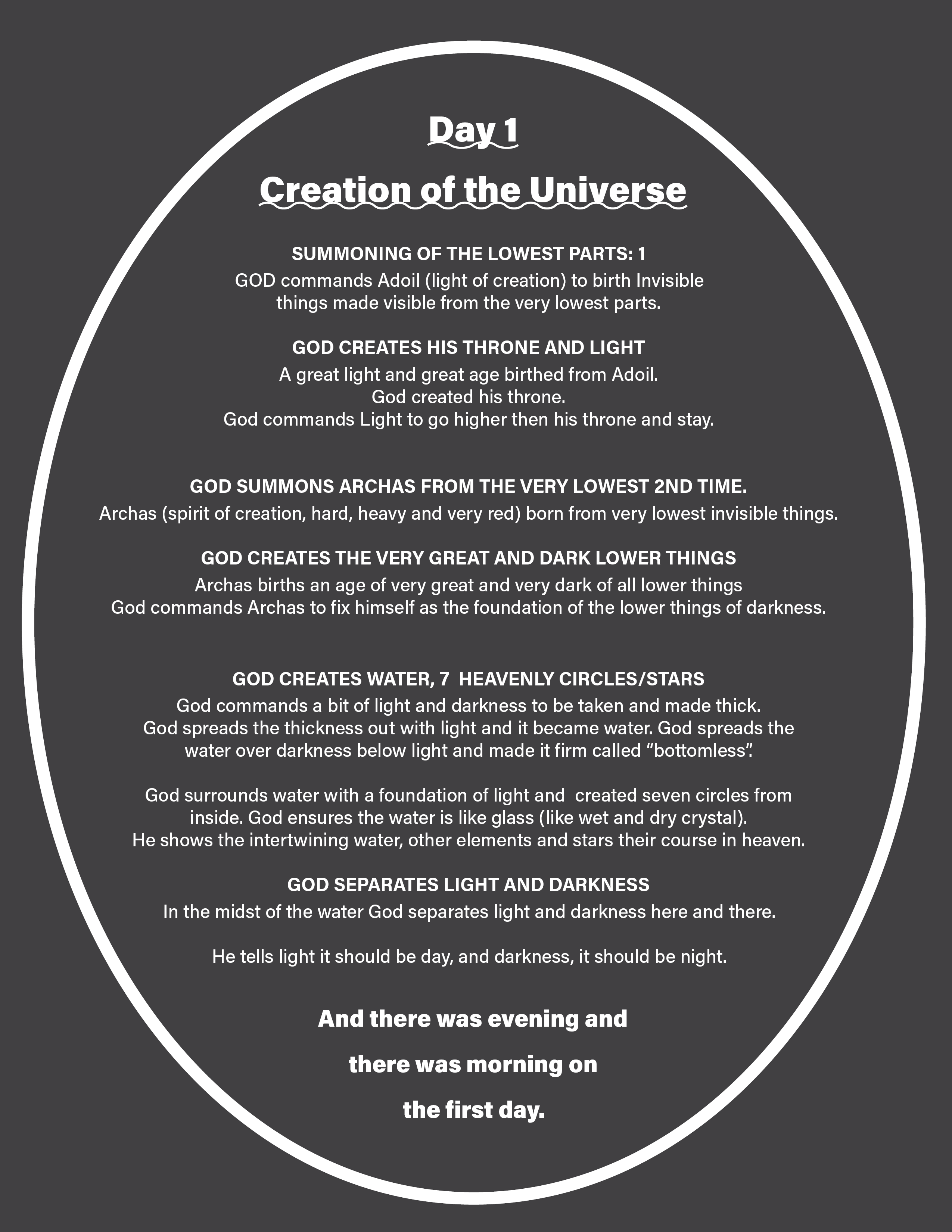
Archas and the Lower Creation
The narrative next names Archas, associated with redness, heaviness and the lower things. God assigns Adoil above and Archas below, creating a striking contrast between light and darkness, height and depth.
Text and interpretation: Some English translations personify Adoil and Archas with masculine pronouns. Whether they should be understood as personal beings, primordial substances or literary personifications is an interpretive question—not something the surviving textual history settles simply.

The Heavenly Troops and the Second Day
My diagram places the fiery heavenly orders on the second creative day. I connected the text’s fall of an angelic order with the larger biblical theme of spiritual rebellion.
Psalm 90:4 and 2 Peter 3:8 compare a thousand years with a day before God, emphasizing that God is not constrained by human time. They do not provide a mathematical key for converting each creation day into exactly one thousand years.
Personal hypothesis: My ideas about nine remaining troops, multiple cosmic circles, restricted resources and rebellious beings’ technology go beyond what the biblical passages establish. They are questions raised by my reading, not verified descriptions of the universe.

Cherubim, Eden and the Question of the Guard
Genesis 3:24 says that God stationed cherubim and a flaming sword east of Eden to guard the way to the tree of life. The text clearly states what was guarded; it does not explicitly identify Satan or angelic troops as the intended intruders.
I found myself wondering whether the guards also represented protection against rebellious spiritual beings. This remains my speculation. Ezekiel 28 uses exalted Edenic and cherubic language in a lament over the king of Tyre; Christians differ over whether and how the passage also points beyond that human ruler to Satan.

The Familiar Pattern of Earthly Life
At this point in the sequence, the imagery becomes more recognisable beside Genesis: the ordering of the world and the appearance of earthly life. The overlap is interesting, while the differences remind me not to flatten two distinct works into one account.

Human Thought and Angelic Swiftness
The description of humanity’s mind as “swift” jumped out at me. I read it as a remarkable statement about human thought and our likeness to God’s intended order.
I also wondered whether stories of swift angelic movement might help explain modern reports of unidentified aerial phenomena. That is a personal association only: neither 2 Enoch nor the biblical creation account demonstrates that UFO or UAP sightings are angelic activity.

Adam and the Four Corners of the World
2 Enoch contains a Greek wordplay in which the name Adam is associated with the initial letters of the Greek terms for the four directions. This explains why the pattern works through Greek direction names rather than through the Hebrew etymology supplied by Genesis.
In Genesis, “Adam” is connected with adamah, the ground or soil. The Greek directional acrostic is therefore best understood as a later literary explanation preserved in 2 Enoch, not as the historical origin of the Hebrew name. My additional connections involving the remaining letters are exploratory wordplay.

An Interpretation Checkpoint
| Statement | How to read it |
|---|---|
| Genesis says Enoch walked with God and was taken. | Biblical text |
| 2 Enoch narrates heavenly journeys, secrets of creation, Adoil and Archas. | Content of a noncanonical ancient work; wording varies across recensions |
| The disciple Jesus loved was John. | Traditional identification; the Gospel itself leaves the disciple unnamed |
| A “great age” equals millions or zillions of years. | Personal inference, not a measurement supplied by the text |
| Eden’s cherubim were guarding against Satan’s troops. | Personal hypothesis; Genesis does not state this |
| UFO sightings are connected with angelic movement. | Speculative association, not established by the cited sources |
✨ Deep Treasure: Curiosity With Discernment
2 Enoch can stretch the imagination and illuminate ancient questions about heaven, creation and humanity. Yet fascination is not the same as certainty. The treasure is learning to ask boldly, read closely and label every conclusion honestly.
My illustrations are not meant to replace Genesis or settle 2 Enoch’s complicated textual history. They show the pathway of my own study—and invite readers to compare the ancient work, the biblical text and my interpretation for themselves.
Frequently Asked Questions
Is 2 Enoch the same book as 1 Enoch?
No. They are separate works with different manuscript histories and content. Scholars use the numbers 1, 2 and 3 to distinguish three Enochic writings.
Is 2 Enoch part of the Bible?
It is not included in the biblical canon recognised by most Jewish and Christian traditions. This post studies it as ancient religious literature.
Who are Adoil and Archas?
They appear in 2 Enoch’s creation narrative. Depending on translation and interpretation, readers may understand them as personified primordial realities, beings or literary figures associated with upper light and lower creation.
Does 2 Enoch prove that creation took vast geological ages?
No. The language stimulated that question for me, but it does not provide a scientific chronology or a numerical conversion into earthly years.
Why are there seven illustrations for six creative days?
The first six follow the creative sequence; the seventh focuses separately on the text’s account of Adam’s name and the four directions.
Sources and Further Reading
Read 2 Enoch in context and note which translation or recension you are using. The Marquette University resource provides both a text and an overview of the surviving Slavonic manuscript tradition.
No comments:
Post a Comment